

Cisco CCIE Enterprise
- Exam: 350-401 (Implementing Cisco Enterprise Network Core Technologies (ENCOR))
- Certification: CCIE Enterprise (Cisco Certified Internetwork Expert Enterprise)
- Certification Provider: Cisco
100% Updated Cisco CCIE Enterprise Certification 350-401 Exam Dumps
Cisco CCIE Enterprise 350-401 Practice Test Questions, CCIE Enterprise Exam Dumps, Verified Answers
-
-

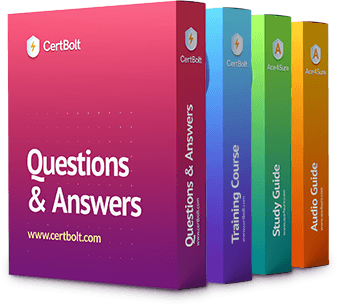
350-401 Questions & Answers
743 Questions & Answers
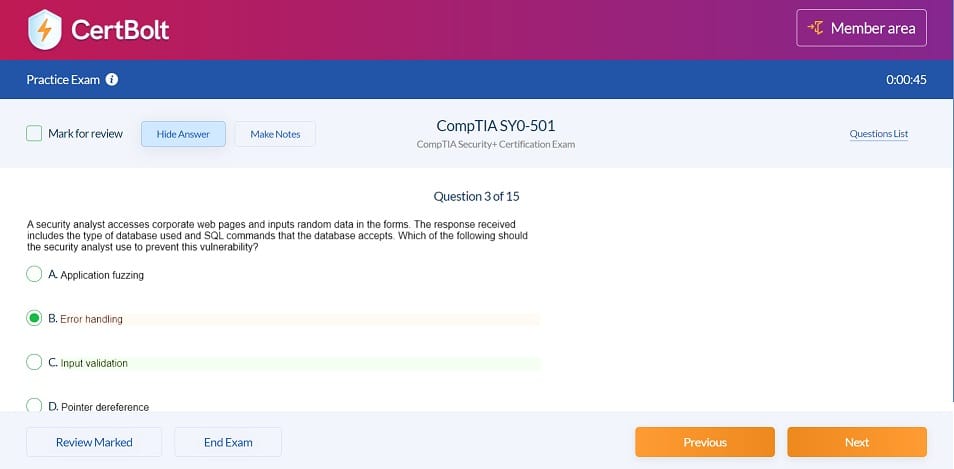
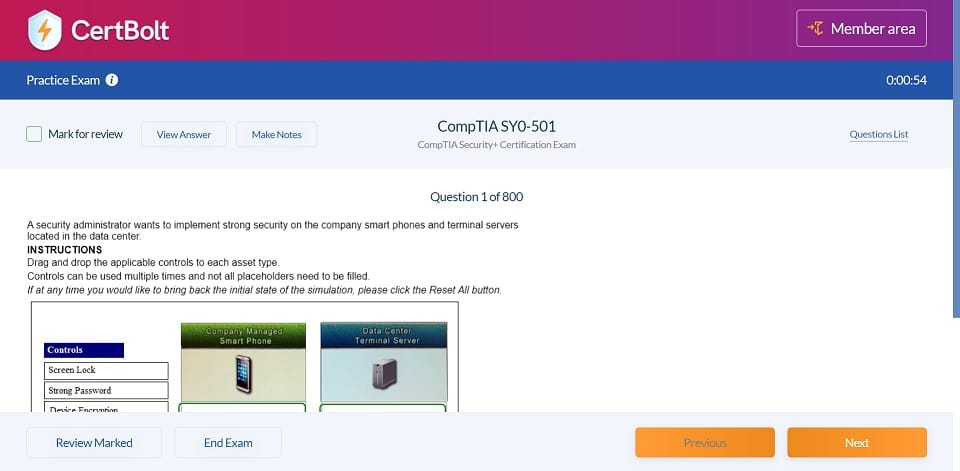
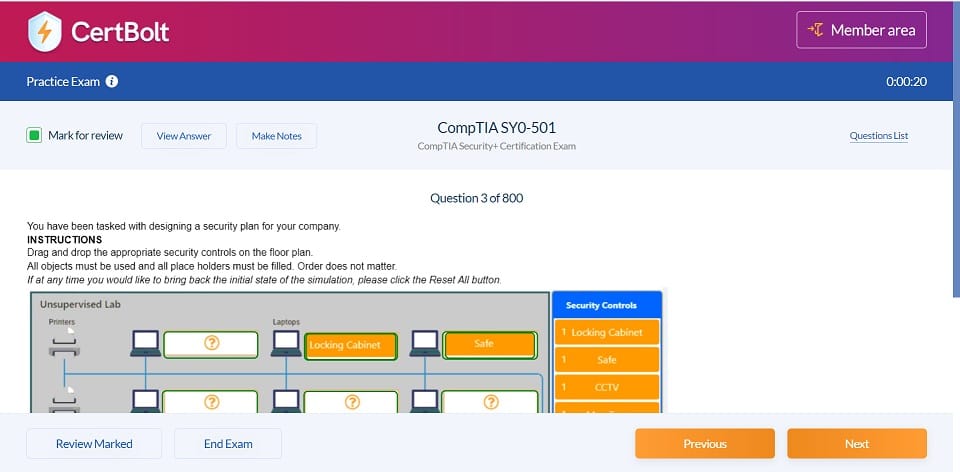
Includes 100% Updated 350-401 exam questions types found on exam such as drag and drop, simulation, type in, and fill in the blank. Fast updates, accurate answers for Cisco CCIE Enterprise 350-401 exam. Exam Simulator Included!
-
350-401 Online Training Course
196 Video Lectures
Learn from Top Industry Professionals who provide detailed video lectures based on 100% Latest Scenarios which you will encounter in exam.
-

350-401 Study Guide
636 PDF Pages
Study Guide developed by industry experts who have written exams in the past. Covers in-depth knowledge which includes Entire Exam Blueprint.
-
-
Cisco CCIE Enterprise Certification Practice Test Questions, Cisco CCIE Enterprise Certification Exam Dumps
Latest Cisco CCIE Enterprise Certification Practice Test Questions & Exam Dumps for Studying. Cram Your Way to Pass with 100% Accurate Cisco CCIE Enterprise Certification Exam Dumps Questions & Answers. Verified By IT Experts for Providing the 100% Accurate Cisco CCIE Enterprise Exam Dumps & Cisco CCIE Enterprise Certification Practice Test Questions.
Step-by-Step Strategy to Pass the CCIE Enterprise Infrastructure v1.1 Lab Exam Using INE
The CCIE Enterprise Infrastructure Lab Exam is widely regarded as one of the most challenging and prestigious technical certifications in the networking industry. It is an eight-hour hands-on examination that tests a candidate's ability to design, deploy, operate, and optimize complex enterprise network infrastructures under real-world conditions and strict time pressure. Unlike written exams that reward memorization, the lab exam demands deep operational fluency across a broad range of technologies, requiring candidates to troubleshoot live network faults, configure intricate protocols, and optimize entire network environments simultaneously.
Version 1.1 of the exam reflects Cisco's updated blueprint that incorporates modern enterprise technologies alongside foundational networking principles. The exam is divided into two primary sections: a design module that tests architectural thinking and a hands-on lab module that requires candidates to configure and troubleshoot actual network equipment. Together, these sections assess whether a candidate is truly ready to operate at the expert level that the CCIE designation represents. Understanding what the exam demands before beginning any structured preparation is the essential first step toward building a strategy that actually works.
Why INE Stands Apart
INE, or Internet Network Engineers, has established itself as one of the most respected and comprehensive training platforms for candidates pursuing the CCIE Enterprise Infrastructure certification. The platform was built by former CCIE holders and experienced networking instructors who understand the lab exam from the inside, having sat through it themselves and coached thousands of candidates to success. This practitioner-first approach gives INE's content a level of depth and practical relevance that sets it apart from platforms that produce content primarily for lower-level certifications or less demanding exams.
What makes INE particularly valuable for CCIE candidates is the combination of structured video instruction, detailed written materials, and a robust practice lab environment that closely mirrors the conditions of the actual Cisco lab exam. INE's workbooks are considered industry standard references among CCIE candidates and cover every technology domain on the blueprint with a level of detail that rewards serious, committed study. The platform also provides access to a community of fellow candidates and certified professionals who share strategies, discuss challenging topics, and provide motivation during what is often a multi-year preparation journey.
Assessing Your Starting Point
Before diving into INE content or any structured study plan, every CCIE candidate must conduct an honest and thorough assessment of where their current knowledge and skill level actually stands. This self-assessment is not about passing judgment but about making intelligent decisions regarding how to allocate the finite study time available. Candidates who overestimate their existing knowledge risk skipping foundational content that is necessary for the exam, while those who underestimate themselves may spend excessive time on topics they already know well, leaving insufficient time for areas that genuinely need attention.
A practical way to begin this assessment is by reviewing the official Cisco CCIE Enterprise Infrastructure v1.1 blueprint and rating your confidence level for each topic area honestly and specifically. Topics where you can configure, troubleshoot, and explain the underlying mechanisms without assistance are genuine strengths. Topics where you can recognize concepts but would struggle under exam pressure are areas needing development. Topics that feel entirely unfamiliar need to be treated as foundational gaps requiring the most attention during the early phases of preparation. This honest map of strengths and weaknesses becomes the foundation of your entire study strategy.
Building Your Study Timeline
Establishing a realistic and well-structured study timeline is one of the most important decisions a CCIE candidate will make during their preparation. Most candidates who succeed at the lab exam spend between one and three years preparing, depending on their starting level of knowledge, the amount of daily study time available, and how efficiently they use that time. Rushing preparation to meet an artificially early exam date is one of the most common reasons candidates fail, as the depth of knowledge required cannot be shortcut without consequences that appear on exam day.
A sensible approach is to divide the preparation into three broad phases. The first phase focuses on technology learning and coverage, where the goal is to work systematically through all blueprint topics using INE video courses and workbooks. The second phase shifts toward intensive lab practice, where the focus moves from learning new material to building speed, accuracy, and confidence through repeated hands-on scenarios. The third phase is a refinement and simulation period in the weeks immediately before the exam, where candidates simulate full eight-hour lab sessions and focus on eliminating remaining weak points. Mapping each phase to specific calendar dates creates accountability and prevents the preparation from drifting without direction.
Systematic INE Content Approach
INE's content library for CCIE Enterprise Infrastructure is extensive, and approaching it without a systematic plan can lead to fragmented learning that does not translate into lab performance. The most effective approach is to work through INE's structured learning path for CCIE Enterprise Infrastructure from beginning to end rather than jumping between topics based on interest or apparent difficulty. This sequential approach ensures that foundational concepts are firmly in place before more advanced material is introduced, which makes the advanced content significantly easier to absorb and retain.
For each major topic area, the recommended workflow involves watching the relevant INE video lecture first to build conceptual understanding, then reading the corresponding section of the INE workbook for additional depth and configuration examples, and finally implementing the technology in a lab environment to verify understanding through hands-on practice. This watch, read, and practice cycle is more time-intensive than passive video consumption but produces a qualitatively deeper level of understanding that holds up under the pressure of an eight-hour exam. Skipping the hands-on practice step, even when you feel confident after watching and reading, is a mistake that consistently costs candidates points on exam day.
Routing Protocol Deep Preparation
Routing protocols form the backbone of the CCIE Enterprise Infrastructure exam, and no area of the blueprint demands more thorough preparation than this one. The exam tests not only the ability to configure protocols like OSPF, EIGRP, and BGP correctly but also the ability to troubleshoot complex, multi-layer routing issues under time pressure and optimize routing behavior to meet specific design requirements. This requires a level of fluency that goes well beyond knowing what commands to type and extends into a deep intuitive grasp of how each protocol behaves, why it makes the decisions it makes, and how those decisions interact with other protocols running simultaneously.
INE's routing protocol content is among the deepest available from any training provider, covering advanced topics such as OSPF LSA types and their role in topology distribution, EIGRP named mode configuration and its advantages over classic mode, and BGP path selection attributes, route reflection, and policy implementation using route maps and prefix lists. Candidates should work through every INE lab scenario related to routing protocols multiple times until they can complete each one accurately without referring to notes or command references. The ability to configure and troubleshoot routing protocols from memory under time pressure is not optional for passing the CCIE lab; it is the minimum standard the exam requires.
Switching And Spanning Tree Mastery
Campus switching technologies and Spanning Tree Protocol in its various forms are another core pillar of the CCIE Enterprise Infrastructure exam that demands dedicated and intensive preparation. The exam covers VLANs, trunking, EtherChannel, STP variants including RSTP and MSTP, Layer 3 switching with SVIs and routed ports, private VLANs, and advanced features like DHCP snooping, dynamic ARP inspection, and storm control. These technologies must be not just configured correctly but also understood deeply enough to troubleshoot unusual failure scenarios that the exam presents in its troubleshooting section.
INE's switching content covers all of these areas in detail and provides lab scenarios that combine multiple switching technologies in realistic topologies that reflect how real enterprise campus networks are actually built. One of the most valuable habits a candidate can develop during this phase of preparation is the practice of drawing the topology and tracing the logical flow of frames before touching the command line. This discipline of thinking before typing is enormously valuable in the exam environment, where hasty configurations that create switching loops or VLAN mismatches can waste significant time to diagnose and resolve. Building this habit during practice makes it automatic under exam pressure.
SD-WAN And Automation Topics
The CCIE Enterprise Infrastructure v1.1 blueprint includes a significant emphasis on software-defined networking and automation technologies that reflect the direction enterprise networking has taken in recent years. Cisco's SD-WAN solution, formerly known as Viptela, is a key component of the exam and covers topics including the SD-WAN architecture with vManage, vBond, and vSmart controllers, onboarding of WAN Edge devices, template configuration, centralized data policies, and application-aware routing. These topics require a different way of thinking compared to traditional CLI-based networking and take time to absorb properly.
Automation topics on the exam include Python scripting for network automation, REST API interaction with network devices and controllers, NETCONF and YANG data models, and the use of tools such as Ansible for configuration management. INE provides dedicated content on these topics that is tailored specifically to what the CCIE exam requires rather than covering automation in a broader software engineering context. Candidates who have strong traditional networking backgrounds but limited automation experience should allocate additional time to these areas and practice writing and running basic scripts in a Python environment to build the hands-on fluency that scenario-based exam questions will demand.
Wireless Networking Preparation
Wireless networking is another significant domain within the CCIE Enterprise Infrastructure blueprint and one that many candidates with primarily wired networking backgrounds find challenging. The exam covers wireless fundamentals including RF principles, 802.11 standards, and antenna theory as well as practical implementation topics such as configuring Cisco Catalyst Center for wireless management, deploying access points in various modes, implementing wireless security using WPA3 and 802.1X, and troubleshooting wireless client connectivity issues. The breadth of wireless content on the exam demands dedicated preparation time rather than treating it as a secondary or lesser domain.
INE's wireless content for CCIE Enterprise Infrastructure walks candidates through both the conceptual foundations and the practical configuration tasks associated with Cisco's wireless architecture. One area that candidates often underestimate is the integration between wireless and wired infrastructure, including how QoS policies applied in the wired network affect wireless traffic, how VLAN designs support wireless segmentation, and how features like FlexConnect affect data plane behavior when WAN connectivity is disrupted. Understanding these integration points is what distinguishes candidates who can handle real-world wireless deployments from those who can only configure wireless systems in isolation.
Lab Practice Environment Setup
Having access to a reliable and realistic lab practice environment is non-negotiable for CCIE preparation, and the quality of your practice environment will directly influence the quality of your preparation. INE provides a cloud-based lab environment that gives candidates access to virtual Cisco devices preconfigured for specific lab scenarios, eliminating the need to build and maintain physical lab equipment at home. This removes a significant financial and logistical barrier that previously limited access to realistic CCIE practice for many candidates worldwide.
Candidates who prefer to supplement INE's cloud labs with their own environments can use Cisco Modeling Labs, commonly referred to as CML, which allows them to build custom network topologies using virtual IOS-XE, IOS-XR, and NX-OS devices on their own hardware or in a cloud environment. The advantage of having your own CML environment is the freedom to build custom scenarios, experiment with configurations beyond the provided lab scenarios, and practice tasks like multicast or QoS in isolation before combining them with other technologies in full-topology scenarios. Regardless of which lab environment you use, the key is consistency: practicing in a realistic environment every single day produces far better results than intensive weekend sessions separated by days of inactivity.
Troubleshooting Skills Development
Troubleshooting is one of the two main components of the CCIE Enterprise Infrastructure lab exam and is evaluated in a dedicated section where candidates are presented with a pre-configured network containing deliberate faults that they must identify and resolve within a defined time limit. This section tests not only whether candidates know the correct configuration for a given technology but whether they can systematically diagnose why a network is not behaving as expected and make precise, targeted corrections without introducing new problems in the process.
Developing strong troubleshooting skills requires a different kind of practice than configuration-focused study. Rather than working from scratch on a blank topology, troubleshooting practice involves working with a network that is mostly correct but contains one or more specific faults. INE's troubleshooting labs provide exactly this kind of practice, presenting candidates with faulty configurations and requiring them to diagnose the problem using show commands, debug outputs, and logical analysis before making corrections. The most effective troubleshooting candidates develop a systematic methodology, typically moving from Layer 1 upward through the protocol stack, that they apply consistently regardless of the technology involved, which prevents the panic-driven guessing that wastes time in the exam.
Time Management During Exam
Time management is arguably the most underappreciated skill in CCIE lab exam preparation. The exam gives candidates eight hours to work through a substantial volume of tasks across multiple technology domains, and without a disciplined approach to time allocation, it is easy to spend excessive time on a single difficult task while leaving other sections incomplete. Incomplete sections receive zero points, meaning a candidate who gets stuck on one challenging configuration and neglects other tasks will fail even if their understanding of the overall content is strong.
INE's exam strategy resources address time management explicitly and recommend specific approaches such as working through tasks in order, placing a time budget on each section before beginning, marking difficult tasks for return rather than spending unlimited time on a single problem, and reviewing completed sections for errors during any remaining time at the end. Practicing full eight-hour lab simulations during preparation is the only way to develop genuine exam-pace efficiency, because working under realistic time pressure reveals habits and inefficiencies that shorter practice sessions never expose. Candidates who have never experienced the fatigue and cognitive pressure of a full eight-hour session before exam day are likely to be caught off guard by how differently their mind performs under those conditions.
Mental Preparation And Endurance
The physical and mental demands of an eight-hour technical exam are significant and should not be overlooked during preparation. Candidates who enter the exam well-rested, properly nourished, and mentally composed perform noticeably better than those who arrive exhausted from last-minute cramming or anxious from inadequate preparation. Building endurance for sustained technical concentration over eight hours is a genuine skill that must be developed through practice, just like any other aspect of the exam, and it cannot be developed without deliberately subjecting yourself to extended periods of focused work during your preparation.
In the weeks leading up to the exam, candidates should practice sitting for extended study and lab sessions of four to six hours without taking breaks beyond what the exam itself allows. This builds the mental stamina and focus required to maintain quality of thinking and decision-making late into the exam day, when fatigue tends to make even familiar tasks feel more difficult. Equally important is managing the psychological pressure that comes with knowing the stakes of the exam. Developing confidence through thorough preparation, maintaining a realistic perspective about what passing requires, and using breathing or focus techniques to manage stress in the moment are all legitimate parts of a complete exam preparation strategy.
Reviewing INE Mock Labs
INE's mock lab scenarios are among the most valuable assets available to CCIE candidates in the final stages of preparation. These full-length, exam-simulating lab scenarios are designed to reflect the structure, complexity, and technology mix of the actual Cisco lab exam and provide candidates with the closest thing to a real exam experience that is available outside of Cisco's own testing facilities. Working through mock labs gives candidates the opportunity to apply everything they have learned in a high-pressure, time-constrained context that reveals how well their preparation has translated into actual exam performance.
After completing each mock lab, candidates should conduct a thorough review of every task they did not complete perfectly, tracing each error or omission back to a specific knowledge gap or procedural misstep that can be addressed through targeted additional study. This post-lab review process is where a significant portion of the learning from mock lab practice actually takes place, and candidates who skip this step in favor of immediately moving on to the next scenario miss a crucial opportunity for improvement. Tracking performance across multiple mock lab attempts over time also gives candidates a data-driven view of their progress and helps them make informed decisions about when they are genuinely ready to schedule their exam attempt.
Scheduling Your Exam Strategically
The decision of when to schedule the CCIE lab exam should be based on objective evidence of readiness rather than calendar pressure or financial motivation to stop paying for training resources. The most reliable indicators of readiness are consistent, high performance on full-length INE mock labs completed under realistic exam conditions, the ability to configure and troubleshoot every major blueprint topic without assistance, and a troubleshooting methodology that reliably diagnoses common failure scenarios within a reasonable time frame. Candidates who can consistently achieve these standards are genuinely ready; those who cannot are not, regardless of how long they have been preparing.
Cisco administers the CCIE lab exam at dedicated lab locations around the world, and availability at preferred locations can be limited, particularly at sites in major cities or during peak certification season. Candidates should research available dates and locations well in advance and build their final preparation timeline backward from their intended exam date to ensure that all preparation phases, including mock lab simulation and final refinement, can be completed before the scheduled date. Arriving at the exam location the day before is advisable for candidates traveling from a distance, as the logistics of travel combined with exam anxiety can be significantly destabilizing if experienced on the morning of the exam itself.
After The Exam Results
Receiving the results of a CCIE lab exam attempt is an emotionally significant moment regardless of the outcome, and having a plan for how to respond to either result helps candidates navigate that moment constructively. Candidates who pass receive their CCIE number, a credential that is recognized globally as a mark of elite networking expertise and that opens doors to senior engineering roles, consulting opportunities, and significant salary increases in markets around the world. For those who pass, the completion of the CCIE journey is a milestone worth celebrating before turning attention to recertification requirements, which must be met every three years.
Candidates who do not pass on their first attempt receive a score report that breaks performance down by section, providing valuable diagnostic information about which areas need additional development before the next attempt. Rather than treating a failed attempt as a setback, experienced candidates and coaches consistently advise treating it as the most expensive and realistic mock lab you will ever take. The insights provided by an actual exam attempt, including exposure to the pace, pressure, and specific challenge areas of the real exam, are genuinely difficult to replicate in any practice environment. Most CCIE holders passed on a second or subsequent attempt, and the discipline of returning to structured preparation with the specific feedback from a prior attempt is a proven path to eventual success.
Conclusion
Passing the CCIE Enterprise Infrastructure v1.1 Lab Exam using INE as your primary preparation platform is absolutely achievable, but it demands a level of commitment, discipline, and intellectual engagement that separates this credential from virtually every other certification in the networking industry. The strategy outlined throughout this article is not a shortcut but a structured and proven approach that gives every candidate who follows it with genuine dedication the best possible chance of walking out of the Cisco lab with a CCIE number. There are no substitutes for deep understanding, consistent hands-on practice, and the willingness to identify and address your own weaknesses honestly and without ego.
INE's resources are exceptional, but they only produce results when engaged with actively and systematically rather than passively consumed as background content. Watching a video lecture without practicing the technology in a lab, or completing a lab scenario without reviewing what went wrong, produces a fraction of the learning value of the same time spent with full engagement and intentionality. The candidates who succeed at the CCIE lab exam are not necessarily the most naturally gifted engineers; they are the ones who committed to the process completely, maintained that commitment through the inevitable periods of frustration and self-doubt that every serious CCIE candidate experiences, and trusted that consistent, quality effort applied over sufficient time would eventually produce the result they were working toward.
The CCIE is not a certification you earn by being lucky on a particular day. It is a credential that reflects who you have become as an engineer through a sustained process of learning, practicing, failing at specific things, improving those specific things, and continuing forward. When you finally earn it, you will know with certainty that it reflects genuine expertise rather than a fortunate test result, and that knowledge is perhaps the most valuable thing the CCIE journey gives you. Begin with INE, follow the strategy, trust the process, and commit fully to becoming the engineer that the CCIE designation represents. The credential and everything it opens for your career will follow.
Pass your next exam with Cisco CCIE Enterprise certification exam dumps, practice test questions and answers, study guide, video training course. Pass hassle free and prepare with Certbolt which provide the students with shortcut to pass by using Cisco CCIE Enterprise certification exam dumps, practice test questions and answers, video training course & study guide.
-
Cisco CCIE Enterprise Certification Exam Dumps, Cisco CCIE Enterprise Practice Test Questions And Answers
Got questions about Cisco CCIE Enterprise exam dumps, Cisco CCIE Enterprise practice test questions?
Click Here to Read FAQ -
-
Top Cisco Exams
- 200-301 - Cisco Certified Network Associate (CCNA)
- 350-401 - Implementing Cisco Enterprise Network Core Technologies (ENCOR)
- 300-410 - Implementing Cisco Enterprise Advanced Routing and Services (ENARSI)
- 350-701 - Implementing and Operating Cisco Security Core Technologies
- 300-420 - Designing Cisco Enterprise Networks (ENSLD)
- 300-415 - Implementing Cisco SD-WAN Solutions (ENSDWI)
- 350-601 - Implementing and Operating Cisco Data Center Core Technologies (DCCOR)
- 300-715 - Implementing and Configuring Cisco Identity Services Engine (300-715 SISE)
- 810-110 - Cisco AI Technical Practitioner (AITECH)
- 350-101 - Implementing and Operating Cisco Wireless Core Technologies (WLCOR)
- 350-801 - Implementing Cisco Collaboration Core Technologies (CLCOR)
- 300-710 - Securing Networks with Cisco Firewalls
- 350-501 - Implementing and Operating Cisco Service Provider Network Core Technologies (SPCOR)
- 350-201 - Performing Cybersecurity Using Cisco Security Technologies (CBRCOR)
- 400-007 - Cisco Certified Design Expert
- 500-220 - Cisco Meraki Solutions Specialist
- 200-901 - DevNet Associate (DEVASC)
- 100-150 - Cisco Certified Support Technician (CCST) Networking
- 300-730 - Implementing Secure Solutions with Virtual Private Networks (SVPN 300-730)
- 200-201 - Understanding Cisco Cybersecurity Operations Fundamentals (CBROPS)
- 300-620 - Implementing Cisco Application Centric Infrastructure (DCACI)
- 350-901 - Designing, Deploying, and Managing Network Automation Systems
- 300-640 - Implementing Cisco Data Center AI Infrastructure (DCAI)
- 820-605 - Cisco Customer Success Manager (CSM)
- 300-435 - Automating Cisco Enterprise Solutions (ENAUTO)
- 300-745 - Designing Cisco Security Infrastructure
- 300-510 - Implementing Cisco Service Provider Advanced Routing Solutions (SPRI)
- 300-110 - Designing Cisco Wireless Networks (WLSD)
- 800-150 - Supporting Cisco Devices for Field Technicians
- 300-720 - Securing Email with Cisco Email Security Appliance (300-720 SESA)
- 300-440 - Designing and Implementing Cloud Connectivity (ENCC)
- 300-425 - Designing Cisco Enterprise Wireless Networks (300-425 ENWLSD)
- 300-215 - Conducting Forensic Analysis and Incident Response Using Cisco CyberOps Technologies (CBRFIR)
- 100-160 - Cisco Certified Support Technician (CCST) Cybersecurity
- 100-140 - Cisco Certified Support Technician (CCST) IT Support
- 300-815 - Implementing Cisco Advanced Call Control and Mobility Services (CLASSM)
- 300-220 - Conducting Threat Hunting and Defending using Cisco Technologies for Cybersecurity
- 700-805 - Cisco Renewals Manager (CRM)
- 500-442 - Administering Cisco Contact Center Enterprise
- 300-610 - Designing Cisco Data Center Infrastructure for Traditional and AI Workloads
- 300-515 - Implementing Cisco Service Provider VPN Services (SPVI)
- 300-635 - Automating Cisco Data Center Solutions (DCAUTO)
- 300-830 - Implementing Cisco Collaboration Cloud Customer Experience (CLCCE)
- 700-750 - Cisco Small and Medium Business Engineer
- 700-242 - Cisco Environmental Sustainability Fundamentals - Stage 1 (CESF)
- 500-560 - Cisco Networking: On-Premise and Cloud Solutions (OCSE)
- 500-470 - Cisco Enterprise Networks SDA, SDWAN and ISE Exam for System Engineers (ENSDENG)
- 500-443 - Advanced Administration and Reporting of Contact Center Enterprise
- 300-820 - Implementing Cisco Collaboration Cloud and Edge Solutions
- 300-725 - Securing the Web with Cisco Web Security Appliance (300-725 SWSA)
- 300-615 - Troubleshooting Cisco Data Center Infrastructure (DCIT)
- 300-445 - Designing and Implementing Enterprise Network Assurance
- 010-151 - Supporting Cisco Data Center System Devices (DCTECH)
-
Purchase Cisco 350-401 Exam Training Products Individually
Last Week Results!
Get Questions & Answers PDF Version
With the PDF Version of the exam questions, you can study at any time and place, which are convenient to you. This means that you can work with the CCIE Enterprise Questions & Answers PDF Version on your PC or use it on your portable device while on the way to your work or home. The PDF exam file also offers you the possibility to print it and use this printed version if you prefer it over the digital one.
Since the file is in the .pdf format, you can open it with a wide range of programs and applications, including Google Docs, OpenOffice, and Adobe Acrobat Reader DC. It is a convenient and easy-to-use option that will help you master new knowledge and skills with relevant materials.
* PDF Version is an add-on to your purchase of CCIE Enterprise Questions & Answers and can't be purchased separately.
Only Registered Members can Download Exam Demo Questions & Answers
Please fill out your email address below in order to download exam demo Questions & Answers.
Registration is Free and Easy, You Simply need to provide a valid email address.
- Trusted by hundreds of IT Certification Candidates Every Month
- 1200+ Exams Available
- Instant download After Registration