

CompTIA CompTIA Security+
- Exam: SY0-701 (CompTIA Security+)
- Certification: CompTIA Security+
- Certification Provider: CompTIA

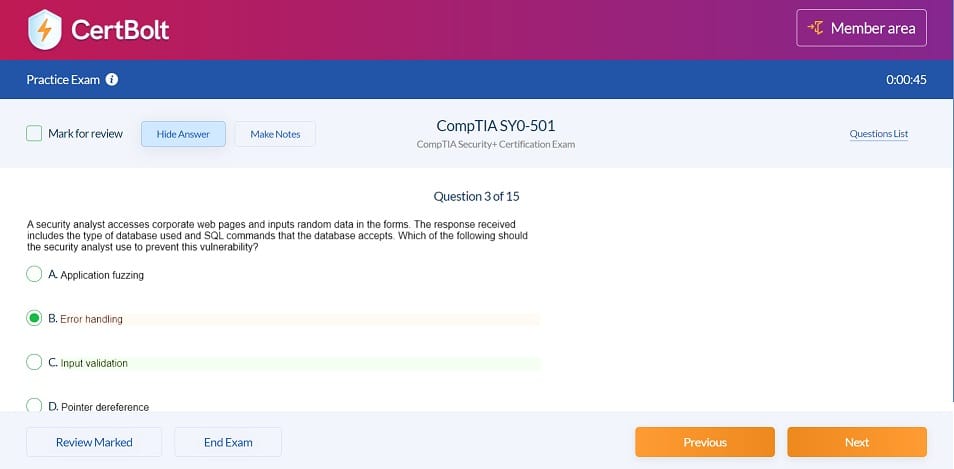
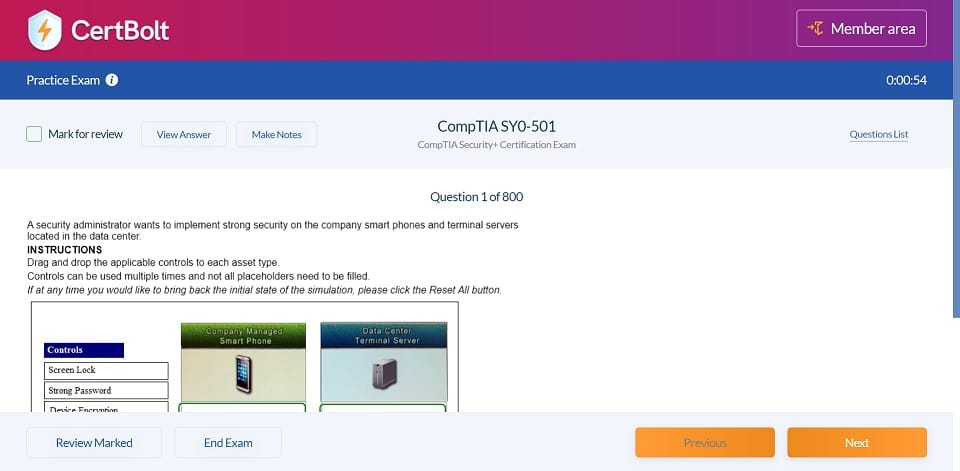
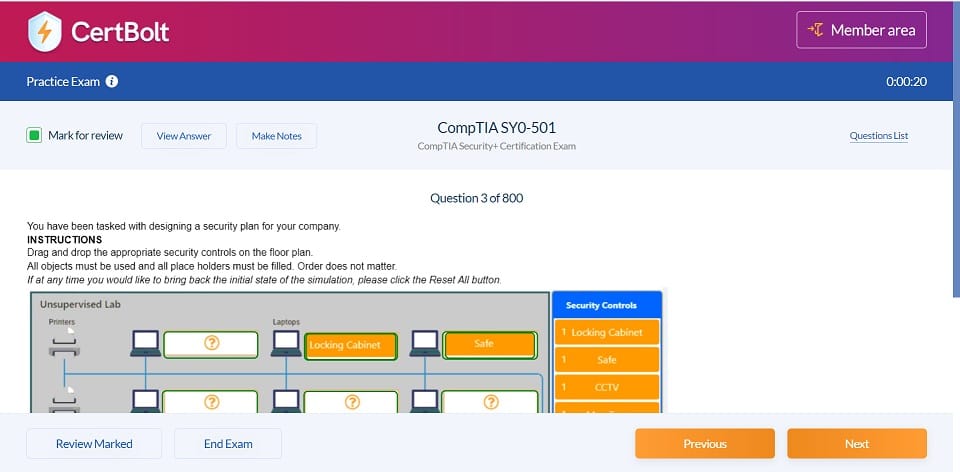
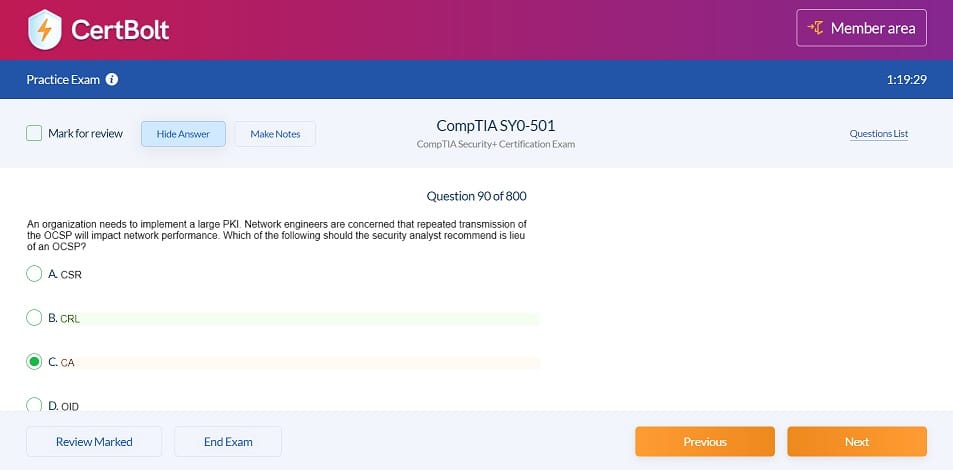
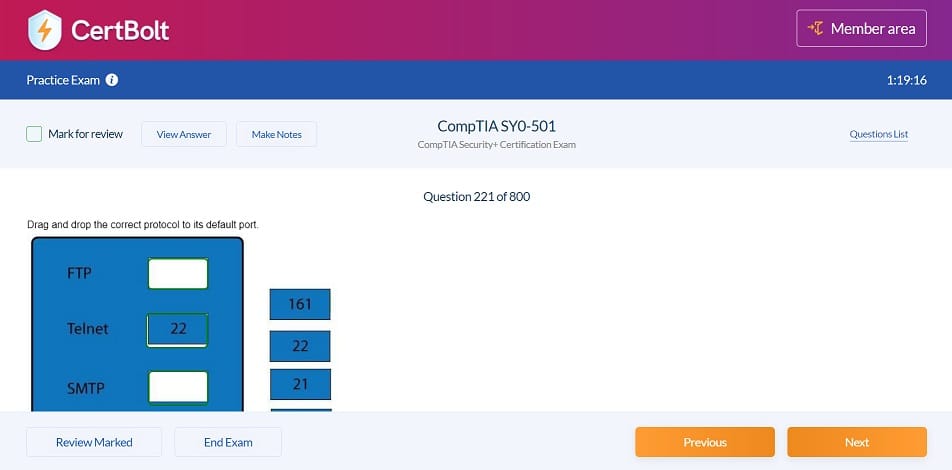
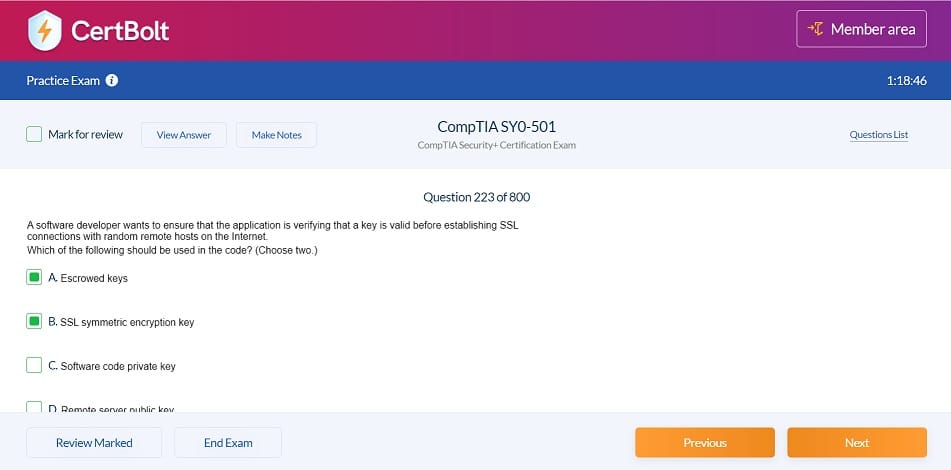
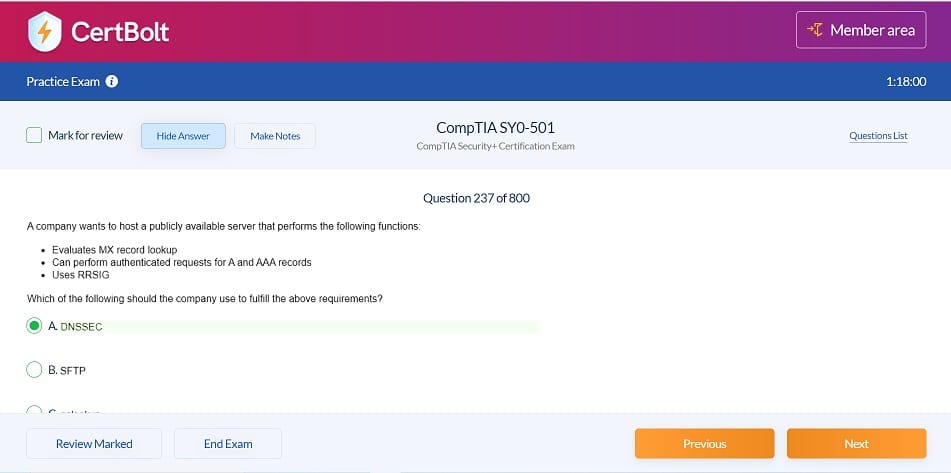
100% Updated CompTIA CompTIA Security+ Certification SY0-701 Exam Dumps
CompTIA CompTIA Security+ SY0-701 Practice Test Questions, CompTIA Security+ Exam Dumps, Verified Answers
-
-

SY0-701 Questions & Answers
1013 Questions & Answers
Includes 100% Updated SY0-701 exam questions types found on exam such as drag and drop, simulation, type in, and fill in the blank. Fast updates, accurate answers for CompTIA CompTIA Security+ SY0-701 exam. Exam Simulator Included!
-
SY0-701 Online Training Course
167 Video Lectures
Learn from Top Industry Professionals who provide detailed video lectures based on 100% Latest Scenarios which you will encounter in exam.
-

SY0-701 Study Guide
1003 PDF Pages
Study Guide developed by industry experts who have written exams in the past. Covers in-depth knowledge which includes Entire Exam Blueprint.
-
-
CompTIA CompTIA Security+ Certification Practice Test Questions, CompTIA CompTIA Security+ Certification Exam Dumps
Latest CompTIA CompTIA Security+ Certification Practice Test Questions & Exam Dumps for Studying. Cram Your Way to Pass with 100% Accurate CompTIA CompTIA Security+ Certification Exam Dumps Questions & Answers. Verified By IT Experts for Providing the 100% Accurate CompTIA CompTIA Security+ Exam Dumps & CompTIA CompTIA Security+ Certification Practice Test Questions.
An Introduction to CompTIA Security+
CompTIA Security+ is a vendor-neutral cybersecurity certification administered by the Computing Technology Industry Association, a nonprofit trade organization that has been producing technology certifications since the early 1990s. The certification was created to address a persistent challenge in the information security field: the absence of a universally recognized baseline credential that employers could use to verify that a candidate possessed the foundational knowledge required to perform security-related work competently. Before credentials like Security+ existed, hiring managers had no reliable way to distinguish between candidates who genuinely understood security concepts and those who had accumulated job titles without the underlying knowledge those titles implied.
The certification exists within a broader ecosystem of CompTIA credentials that spans foundational IT knowledge through advanced technical specializations. Security+ sits at the associate level of this ecosystem, positioned above the foundational CompTIA IT Fundamentals and CompTIA A+ credentials and below the more advanced CompTIA Cybersecurity Analyst and CompTIA Advanced Security Practitioner certifications. This positioning reflects Security+'s role as the entry point for security specialization within the CompTIA framework, serving candidates who have some general IT experience and want to formally commit to a cybersecurity career direction. The credential has become so widely recognized that it now appears as a requirement or strong preference in job postings across government agencies, defense contractors, financial institutions, healthcare organizations, and technology companies in numbers that few other security certifications can match.
The Professional Audience Security+ Is Designed to Serve
Security+ was designed with a specific professional audience in mind, and candidates who fit this profile consistently find that the certification content aligns well with the knowledge they need to build and the roles they are targeting. The primary audience consists of IT professionals with approximately two years of experience in IT administration with a security focus who are ready to formally specialize in cybersecurity. This might include help desk technicians who have developed a strong interest in the security dimensions of their support work, network administrators who want to formalize their security knowledge, and systems administrators who are responsible for securing the servers and infrastructure they manage and want a credential that validates this capability.
The secondary audience for Security+ is broader and includes recent graduates of computer science, information technology, and cybersecurity degree programs who want a certification to complement their academic credentials, career changers coming from non-technical fields who have completed cybersecurity training programs and want to validate their new skills, and military personnel and veterans transitioning to civilian cybersecurity careers who need a credential recognized by the civilian employer market. The US Department of Defense's approval of Security+ under Directive 8140, which establishes baseline certification requirements for government and contractor cybersecurity roles, has made the credential particularly valuable for this military and government-adjacent audience, creating an enormous institutional demand that sustains the certification's relevance and recognition far into the future.
How Security+ Compares to Other Entry-Level Security Credentials
The entry-level security certification market includes several credentialing options beyond Security+, and candidates who take time to compare these options before committing to a preparation path make more informed choices about which credential best serves their specific career goals. The Certified Information Systems Security Professional, while far more prestigious and comprehensive than Security+, requires five years of paid security work experience and is positioned as a senior practitioner credential rather than an entry-level one, making it irrelevant as a direct alternative for most candidates considering Security+. The Systems Security Certified Practitioner from ISC2 is a more direct comparison point, requiring one year of security experience and covering overlapping conceptual territory, but it carries somewhat less name recognition in the general IT job market than Security+.
The Certified Ethical Hacker from EC-Council occupies a different niche, focusing specifically on offensive security techniques and penetration testing methodology rather than the broad defensive security knowledge base that Security+ validates. Candidates who are specifically targeting penetration testing or red team roles may find the CEH more directly relevant to their goals, while those targeting security analyst, security operations, or general IT security roles will find Security+ more broadly applicable. The CompTIA CySA+, which sits above Security+ in the CompTIA credential hierarchy, covers security analyst skills at a deeper level and is the natural next certification for Security+ holders who want to continue advancing within the CompTIA framework. For most candidates beginning their formal cybersecurity career, Security+ provides the best combination of accessibility, recognition, and genuine relevance to the entry-level security roles they are targeting.
The Current Security+ Exam Version and Its Domain Structure
CompTIA periodically updates its certification exams to reflect changes in the threat landscape, the evolution of security technologies, and shifts in the responsibilities of security practitioners, and candidates should always verify which exam version is currently active before beginning preparation. The SY0-701 is the current version of the Security+ examination, having replaced the SY0-601 in late 2023. The SY0-701 organizes its content around five domain areas that together cover the breadth of knowledge expected from an entry-level security practitioner in the current environment.
The five domains of the SY0-701 are general security concepts, threats vulnerabilities and mitigations, security architecture, security operations, and security program management and oversight. General security concepts covers foundational terminology, basic cryptography concepts, authentication and authorization principles, and the security controls framework that organizes protective measures into preventive, detective, corrective, and deterrent categories. Threats vulnerabilities and mitigations covers attack types, social engineering techniques, application vulnerabilities, network attacks, and the mitigation strategies applied to address each category of threat. Security architecture addresses the design of secure networks, cloud environments, and hybrid infrastructures. Security operations covers incident response, digital forensics, vulnerability management, and identity and access management. Security program management and oversight covers governance, risk management, compliance frameworks, data privacy regulations, and security awareness training. Each domain carries a specific percentage weight in the overall exam score, and reviewing the official exam objectives document from CompTIA before beginning preparation ensures that study effort is proportionally distributed.
Threats and Vulnerabilities Content That Candidates Must Know
The threats and vulnerabilities domain is consistently one of the most practically important areas of Security+ preparation, because it covers the attack techniques and threat actor behaviors that security professionals encounter in real defensive work. Social engineering attacks, which exploit human psychology rather than technical vulnerabilities to gain unauthorized access or extract sensitive information, receive substantial coverage in this domain. Phishing, spear phishing, vishing, smishing, whaling, and pretexting are the primary social engineering techniques that candidates must be able to distinguish and describe, along with the organizational and technical countermeasures that reduce their effectiveness. Understanding why social engineering attacks succeed, rooted in psychological principles like authority, urgency, and reciprocity that attackers exploit, provides a conceptual foundation for explaining why technical controls alone are insufficient to address this threat category.
Malware types and their behavioral characteristics form another critical component of this domain. Candidates must be able to distinguish between viruses, worms, trojans, ransomware, spyware, adware, rootkits, keyloggers, and logic bombs based on how each type propagates, what payload it delivers, and how it evades detection. Network attacks including man-in-the-middle attacks, replay attacks, DNS poisoning, ARP spoofing, denial of service, and distributed denial of service attacks are covered alongside the network-level controls that mitigate them. Application-level vulnerabilities including SQL injection, cross-site scripting, cross-site request forgery, buffer overflows, and directory traversal are tested at a conceptual level that requires candidates to understand how each vulnerability arises from flawed coding practices and how defensive coding techniques and application security controls address them.
Cryptography Concepts That Appear Throughout the Exam
Cryptography is one of the most conceptually dense topics in the Security+ curriculum, and it is also one of the most pervasive, appearing not just in the dedicated cryptography sections of the exam but woven throughout questions about network security, application security, identity management, and data protection. The foundational distinction between symmetric and asymmetric encryption algorithms is the starting point for the entire cryptography curriculum. Symmetric encryption uses the same key for both encryption and decryption, which makes it computationally efficient but creates the key distribution challenge of securely sharing that key between communicating parties. AES is the primary symmetric algorithm tested on the exam, and candidates should know its key lengths and its status as the current standard for symmetric encryption in both government and commercial applications.
Asymmetric encryption uses mathematically related key pairs in which data encrypted with the public key can only be decrypted with the corresponding private key, which elegantly solves the key distribution problem at the cost of significantly greater computational overhead. RSA and elliptic curve cryptography are the primary asymmetric algorithms covered in the Security+ curriculum. Hashing algorithms, which produce fixed-length outputs from arbitrary-length inputs in a way that is computationally infeasible to reverse or to find collisions for, are covered through the SHA family of algorithms. The practical applications of these cryptographic primitives in real security systems, including TLS for web traffic encryption, PKI for digital certificate management, and digital signatures for authentication and non-repudiation, give context to the mathematical concepts and help candidates understand why specific algorithms are chosen for specific security applications.
Network Security Architecture and Design Principles
Network security architecture covers the design principles and specific technologies used to protect network infrastructure from unauthorized access and malicious activity, and it is a domain area where candidates with network administration backgrounds will find substantial overlap with knowledge they have already developed. The concept of network segmentation, dividing a flat network into multiple zones with controlled traffic flow between them, is foundational to secure network design. A properly segmented network isolates sensitive systems like databases and internal servers from directly internet-facing systems, contains the blast radius of security incidents by preventing an attacker who has compromised one segment from freely accessing other segments, and enables more precise application of security controls to each segment based on its specific risk profile and data sensitivity.
Firewalls, intrusion detection systems, intrusion prevention systems, and web application firewalls are the primary network security appliances covered in this domain, and candidates must be able to distinguish between their functions, their placement in network architecture, and the specific threat categories each is designed to address. The transition from traditional perimeter-based security models, where a strong outer boundary was assumed to protect a trusted internal network, to zero trust architecture, where no user, device, or network location is inherently trusted and every access request is continuously verified against defined policies, represents one of the most significant conceptual shifts in enterprise security thinking and receives substantial attention in the current Security+ curriculum. Candidates who genuinely grasp the zero trust model, rather than merely recognizing the term, are better prepared for the scenario-based questions that test its practical application.
Cloud Security Concepts in the Security+ Curriculum
Cloud computing has become the dominant infrastructure model for new technology deployments, and Security+ reflects this by dedicating substantial coverage to the security challenges and controls specific to cloud environments. The shared responsibility model, which defines how security responsibilities are divided between cloud service providers and their customers depending on the service model being used, is one of the most important concepts in cloud security and one that appears regularly in Security+ exam questions. In infrastructure as a service environments, customers retain responsibility for securing the operating systems, applications, and data they deploy on provider-managed hardware. In software as a service environments, the provider assumes responsibility for nearly all security controls except those governing data access and identity management.
Cloud-specific security threats including misconfigured storage buckets that expose sensitive data publicly, insecure APIs that allow unauthorized access to cloud management functions, inadequate identity and access management that permits excessive privilege accumulation, and insufficient logging and monitoring that allows malicious activity to proceed undetected are all covered in the Security+ curriculum. The security controls that address these threats, including cloud security posture management tools that continuously assess cloud configuration against security best practices, cloud access security brokers that enforce security policies for cloud service usage, and the specific identity and access management capabilities provided by major cloud platforms, give candidates a practical understanding of how security is implemented and managed in cloud environments that goes beyond theoretical awareness of the threats.
Identity and Access Management Principles and Technologies
Identity and access management is a domain that connects deeply to nearly every other area of security, because controlling who has access to what resources under what conditions is the fundamental security challenge in any computing environment. Authentication is the process of verifying that a user or system is who they claim to be, and the Security+ curriculum covers the three factors of authentication — something you know, something you have, and something you are — along with the specific technologies that implement each factor. Passwords, PINs, and security questions implement knowledge-based authentication. Smart cards, hardware tokens, and mobile authenticator applications implement possession-based authentication. Fingerprints, facial recognition, iris scans, and voice recognition implement biometric authentication.
Multifactor authentication, which requires successful verification through two or more different authentication factors, is covered as the standard approach for securing access to sensitive systems because it eliminates the most significant weakness of single-factor authentication, which is that any single factor can be compromised without compromising the others. Single sign-on systems that allow users to authenticate once and access multiple applications without re-authenticating to each, federation technologies that extend authentication trust across organizational boundaries, and directory services like LDAP and Active Directory that provide the centralized identity stores against which authentication is performed are all covered in this domain. Authorization, the process of determining what an authenticated user is permitted to do, is addressed through access control models including role-based access control, mandatory access control, discretionary access control, and attribute-based access control, each of which has specific properties that make it appropriate for different security requirements.
Incident Response and Digital Forensics Fundamentals
Incident response and digital forensics represent the reactive dimension of security operations, addressing how organizations detect, contain, and recover from security incidents and how investigators collect and analyze evidence to determine what occurred, how it occurred, and what impact it had. The Security+ curriculum covers the incident response lifecycle, which consists of preparation, identification, containment, eradication, recovery, and lessons learned phases. Each phase has specific activities associated with it, and candidates must be able to describe what occurs during each phase and why the sequential progression through these phases produces better outcomes than ad hoc responses that skip or combine phases under the pressure of an active incident.
Digital forensics principles are covered with particular emphasis on the chain of custody, which is the documented record of who has had possession of evidence and what was done with it, and the order of volatility, which guides forensic investigators to collect the most ephemeral evidence first because data like the contents of CPU registers, network connections, and running processes will be permanently lost when a system is powered off or rebooted. Forensic imaging techniques that create exact bit-for-bit copies of storage media for analysis without modifying the original evidence, and hash verification procedures that confirm the integrity of forensic copies, reflect the legal evidentiary standards that digital forensics must meet when investigations may eventually result in legal proceedings. Understanding these principles gives Security+ candidates a foundation for the more specialized forensic skills developed at higher certification levels.
Risk Management and Compliance Framework Knowledge
Risk management and compliance represent the governance dimension of cybersecurity, addressing how organizations systematically identify, assess, prioritize, and manage the security risks they face and how they demonstrate compliance with the legal, regulatory, and contractual requirements that govern their handling of information. The Security+ curriculum covers the risk management process including risk identification, risk analysis through both qualitative methods that assign descriptive severity levels and quantitative methods that calculate financial impact, risk response strategies including risk avoidance, risk transference through insurance or contractual mechanisms, risk mitigation through security controls, and risk acceptance for low-impact risks that are not worth the cost of mitigation.
Compliance frameworks that candidates must be familiar with include NIST, which produces cybersecurity frameworks widely adopted by US government agencies and their contractors, ISO 27001, which is the international standard for information security management systems, PCI DSS, which governs the security of payment card data, HIPAA, which establishes privacy and security requirements for healthcare information, and GDPR, which regulates the processing of personal data for individuals in the European Union. Understanding these frameworks at the level required for Security+ does not involve memorizing every technical requirement but rather grasping the purpose each framework serves, the types of organizations it applies to, the categories of controls it requires, and the consequences of non-compliance. This framework literacy provides context for the security controls and governance structures that the rest of the Security+ curriculum addresses.
Preparing Effectively for the Security+ Examination
Effective preparation for the Security+ examination requires a structured approach that addresses the broad content coverage of the exam through multiple complementary learning methods rather than any single resource or technique. CompTIA's official Security+ study guide provides comprehensive coverage of all exam domains with clear explanations, review questions, and practice exam access that forms a solid backbone for systematic preparation. Professor Messer's Security+ course, available free on his website and YouTube channel, is one of the most widely recommended supplementary resources in the Security+ community, offering video-based instruction that covers every exam objective with a teaching style that many candidates find more accessible than written study guides for initial concept introduction.
Practice examinations are essential preparation tools that serve multiple functions simultaneously. Working through practice questions throughout the preparation period rather than exclusively at the end reveals knowledge gaps while there is still time to address them through additional study. Analyzing the explanations for both correct and incorrect answers deepens conceptual understanding beyond what reading alone typically produces. Taking full-length timed practice exams in the weeks before the actual examination builds the time management discipline and mental stamina needed to maintain accuracy across 90 questions within 90 minutes. Darril Gibson's practice question books, the Jason Dion practice exams on Udemy, and the official CompTIA practice tests are among the most respected practice examination resources, and working through multiple sources exposes candidates to a wider range of question styles and topic emphases than any single resource covers.
The Examination Format and What Candidates Experience on Test Day
The Security+ SY0-701 examination consists of a maximum of 90 questions that must be completed within 90 minutes, with a passing score of 750 on a scale of 100 to 900. The question format includes multiple choice questions with a single correct answer, multiple select questions where candidates must identify all correct answers from a list, and performance-based questions that present interactive scenarios requiring candidates to complete configuration tasks, analyze network diagrams, match security controls to threat scenarios, or work through other applied tasks in simulated environments. Performance-based questions typically appear at the beginning of the examination and tend to be more time-consuming than multiple choice questions, which means candidates should budget their time accordingly rather than spending so long on performance-based questions that they rush through the multiple choice section.
The examination is administered by Pearson VUE at authorized testing centers worldwide and through online proctored delivery for candidates who prefer to test from their own location. Online proctored examinations require a stable internet connection, a functioning webcam, a quiet private testing environment, and valid government-issued identification for the check-in process. Testing center examinations provide a controlled environment that eliminates the technical setup and environmental management requirements of online proctoring, which some candidates find preferable particularly for a high-stakes examination where technical difficulties during check-in would add unnecessary stress. CompTIA recommends that candidates have at least two years of IT administration experience with a security focus before attempting the examination, and candidates who meet this recommendation consistently report feeling more prepared for the scenario-based questions that draw on practical judgment alongside technical knowledge.
Conclusion
CompTIA Security+ has maintained its position as the most widely recognized entry-level cybersecurity certification in the market for good reasons that go beyond historical momentum or institutional inertia. The credential's vendor-neutral design ensures that its content reflects principles and practices that apply across the full range of security tools and platforms a practitioner might encounter rather than validating knowledge of any single vendor's product ecosystem. Its regular update cycle, with new exam versions released every three years to incorporate emerging threats, technologies, and professional responsibilities, keeps the curriculum aligned with the realities of contemporary security work rather than testing knowledge of a threat landscape frozen at a particular point in the past. Its DoD approval and widespread adoption across regulated industries creates a genuine and sustained demand for the credential that translates directly into hiring preference for those who hold it.
For candidates standing at the beginning of their cybersecurity careers, Security+ provides something that is difficult to quantify but profoundly valuable: a structured map of the security knowledge landscape that organizes an otherwise overwhelming field into comprehensible domains with clear relationships between them. The process of preparing for Security+, even before the examination is sat, forces candidates to engage systematically with threat categories they had only vaguely encountered, cryptographic concepts they had used without fully grasping, architectural principles they had implemented by following instructions without understanding the reasoning, and governance frameworks they had heard mentioned without knowing their content. This structured engagement transforms a collection of disconnected security facts into an integrated conceptual framework that makes subsequent learning faster, deeper, and more durable.
The career impact of Security+ extends beyond the job opportunities it creates at the point of initial hiring. Professionals who hold Security+ and continue building on its foundation through experience, additional certifications, and ongoing professional development consistently find that the credential serves as a recognizable marker of their security specialization throughout their careers, providing a common reference point in conversations with colleagues, clients, and employers across the enormous diversity of organizations and roles that the cybersecurity field encompasses. Whether your career ultimately leads toward security operations, penetration testing, security architecture, governance and compliance, cloud security, or any of the other specializations that the field offers, the knowledge foundation that Security+ establishes will remain relevant and useful long after the credential itself has been superseded by more advanced achievements.
Investing seriously in Security+ preparation is therefore not just an investment in passing a single examination. It is an investment in the conceptual architecture of your entire cybersecurity career, building the foundations upon which every subsequent specialization, credential, and professional accomplishment will be constructed. Approach the preparation with genuine intellectual engagement rather than as a credentialing exercise, build hands-on familiarity with the security tools and concepts the curriculum covers, engage with the professional community of security practitioners who share knowledge generously through blogs, podcasts, conferences, and online communities, and treat the certification not as a destination but as the first meaningful waypoint on a career journey that rewards continuous learning, genuine curiosity, and a commitment to protecting the systems and information that organizations and individuals depend upon.
Pass your next exam with CompTIA CompTIA Security+ certification exam dumps, practice test questions and answers, study guide, video training course. Pass hassle free and prepare with Certbolt which provide the students with shortcut to pass by using CompTIA CompTIA Security+ certification exam dumps, practice test questions and answers, video training course & study guide.
-
CompTIA CompTIA Security+ Certification Exam Dumps, CompTIA CompTIA Security+ Practice Test Questions And Answers
Got questions about CompTIA CompTIA Security+ exam dumps, CompTIA CompTIA Security+ practice test questions?
Click Here to Read FAQ -
-
Top CompTIA Exams
- SY0-701 - CompTIA Security+
- N10-009 - CompTIA Network+
- CS0-003 - CompTIA CySA+ (CS0-003)
- CAS-005 - CompTIA SecurityX
- 220-1201 - CompTIA A+ Certification Exam: Core 1
- PT0-003 - CompTIA PenTest+
- 220-1202 - CompTIA A+ Certification Exam: Core 2
- CS0-004 - CompTIA CySA+ V4
- CY0-001 - CompTIA SecAI+
- PK0-005 - CompTIA Project+
- XK0-006 - CompTIA Linux+
- CV0-004 - CompTIA Cloud+
- DA0-002 - CompTIA Data+
- SK0-005 - CompTIA Server+ Certification Exam
- CA1-005 - CompTIA SecurityX
- DY0-001 - CompTIA DataX
- FC0-U71 - CompTIA Tech+
- 220-1102 - CompTIA A+ Certification Exam: Core 2
- 220-1101 - CompTIA A+ Certification Exam: Core 1
- CNX-001 - CompTIA CloudNetX
-
Purchase CompTIA SY0-701 Exam Training Products Individually
Last Week Results!
Get Questions & Answers PDF Version
With the PDF Version of the exam questions, you can study at any time and place, which are convenient to you. This means that you can work with the CompTIA Security+ Questions & Answers PDF Version on your PC or use it on your portable device while on the way to your work or home. The PDF exam file also offers you the possibility to print it and use this printed version if you prefer it over the digital one.
Since the file is in the .pdf format, you can open it with a wide range of programs and applications, including Google Docs, OpenOffice, and Adobe Acrobat Reader DC. It is a convenient and easy-to-use option that will help you master new knowledge and skills with relevant materials.
* PDF Version is an add-on to your purchase of CompTIA Security+ Questions & Answers and can't be purchased separately.
Only Registered Members can Download Exam Demo Questions & Answers
Please fill out your email address below in order to download exam demo Questions & Answers.
Registration is Free and Easy, You Simply need to provide a valid email address.
- Trusted by hundreds of IT Certification Candidates Every Month
- 1200+ Exams Available
- Instant download After Registration