

CompTIA CompTIA Network+
- Exam: N10-009 (CompTIA Network+)
- Certification: CompTIA Network+
- Certification Provider: CompTIA

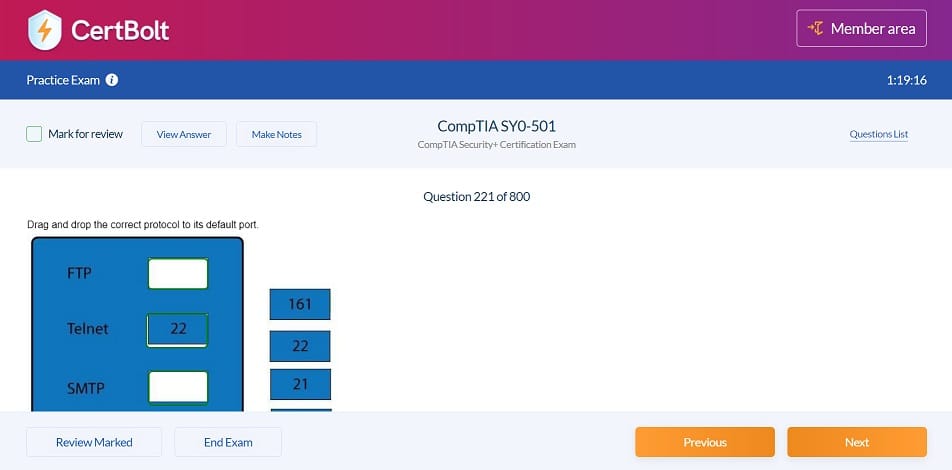
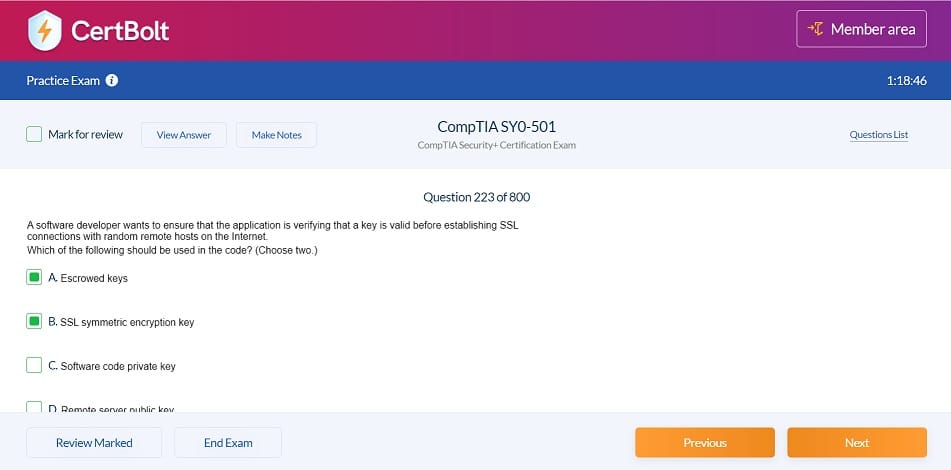
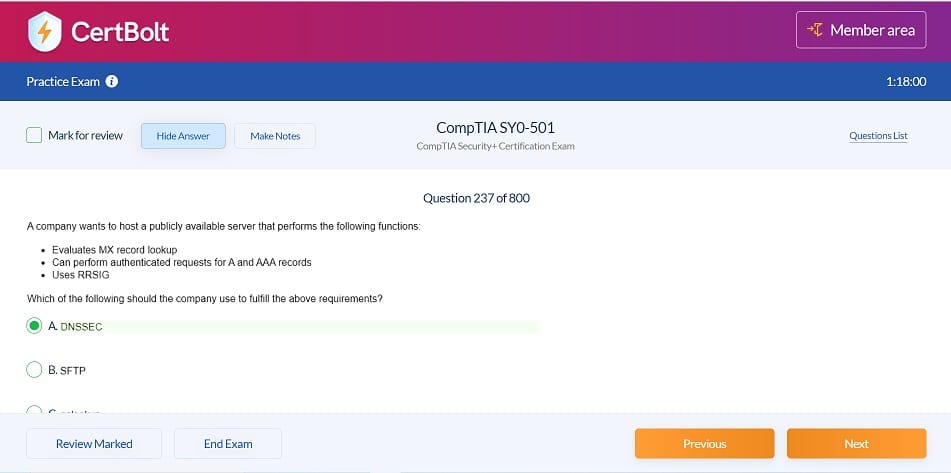
100% Updated CompTIA CompTIA Network+ Certification N10-009 Exam Dumps
CompTIA CompTIA Network+ N10-009 Practice Test Questions, CompTIA Network+ Exam Dumps, Verified Answers
-
-

N10-009 Questions & Answers
768 Questions & Answers
Includes 100% Updated N10-009 exam questions types found on exam such as drag and drop, simulation, type in, and fill in the blank. Fast updates, accurate answers for CompTIA CompTIA Network+ N10-009 exam. Exam Simulator Included!
-

N10-009 Online Training Course
240 Video Lectures
Learn from Top Industry Professionals who provide detailed video lectures based on 100% Latest Scenarios which you will encounter in exam.
-

N10-009 Study Guide
128 PDF Pages
Study Guide developed by industry experts who have written exams in the past. Covers in-depth knowledge which includes Entire Exam Blueprint.
-
-
CompTIA CompTIA Network+ Certification Practice Test Questions, CompTIA CompTIA Network+ Certification Exam Dumps
Latest CompTIA CompTIA Network+ Certification Practice Test Questions & Exam Dumps for Studying. Cram Your Way to Pass with 100% Accurate CompTIA CompTIA Network+ Certification Exam Dumps Questions & Answers. Verified By IT Experts for Providing the 100% Accurate CompTIA CompTIA Network+ Exam Dumps & CompTIA CompTIA Network+ Certification Practice Test Questions.
Modern Networking and the CompTIA Network+ Certification
CompTIA Network+ stands as one of the most recognized vendor-neutral networking certifications available to technology professionals at the early and intermediate stages of their careers. Unlike vendor-specific credentials that validate proficiency with a particular manufacturer's equipment or platform, Network+ certifies foundational networking knowledge applicable across different environments, technologies, and organizational contexts. This vendor neutrality gives the credential a breadth of relevance that makes it valued by employers ranging from small businesses managing their own infrastructure to large enterprises with complex multi-vendor network deployments, government agencies with strict qualification requirements, and managed service providers supporting diverse client environments simultaneously.
The certification occupies a specific and well-defined position in the broader CompTIA certification pathway. It sits above the CompTIA IT Fundamentals and CompTIA A+ credentials, which address general IT literacy and hardware and operating system support respectively, and below the CompTIA Security+ credential and the more specialized CompTIA certifications that address advanced networking, cybersecurity, and cloud topics. This positioning reflects the genuine skill progression that technology careers follow in practice — professionals who understand hardware and operating systems and who then develop solid networking knowledge are well prepared to specialize further into security, cloud infrastructure, or advanced networking roles. Network+ provides the networking foundation that makes those subsequent specializations coherent rather than disconnected from an engineer's existing knowledge base.
How CompTIA Developed and Continues to Refine This Credential
CompTIA introduced the Network+ certification in 1999 as part of its growing portfolio of vendor-neutral credentials designed to address skills gaps across the technology workforce. The organization recognized that networking knowledge represented a distinct competency domain that neither hardware-focused credentials like A+ nor emerging security credentials adequately addressed, and that the rapid growth of networked computing was creating genuine demand for professionals with validated foundational networking skills. The credential quickly gained acceptance among employers and government agencies, with the United States Department of Defense approving it under Directive 8570 as a qualifying credential for information assurance technical roles, which significantly expanded its relevance in defense and government contracting contexts.
CompTIA updates the Network+ examination periodically to ensure its content remains aligned with the actual skills required by current networking roles rather than reflecting the technology landscape of previous years. The current version of the examination reflects the shift toward cloud-connected networking, software-defined infrastructure, wireless technology evolution, and the expanded security responsibilities that modern network administrators carry. Each version revision involves input from industry subject matter experts and employers who validate that the updated content reflects genuine workplace requirements rather than academic constructs. This commitment to current relevance distinguishes actively maintained certifications from credentials whose content has drifted out of alignment with contemporary practice through infrequent or insufficiently thorough revision.
Exam Format Structure and What Candidates Should Anticipate
The Network+ examination consists of a maximum of 90 questions that must be completed within a time limit of 90 minutes, creating a pace requirement of approximately one minute per question that demands both solid content knowledge and efficient test-taking habits. The question pool draws from multiple formats including standard multiple choice questions with a single correct answer, multiple select questions where candidates must identify all correct options from a provided list, and performance-based questions that present interactive scenarios requiring candidates to configure network settings, analyze network diagrams, interpret output from diagnostic commands, or identify issues within described network environments.
Performance-based questions deserve particular attention in preparation because they assess practical application ability rather than knowledge recall, and they typically appear at the beginning of the examination. These questions often take longer to complete than standard multiple choice items because they require candidates to work through a realistic scenario methodically before arriving at an answer. A common strategic recommendation is to skip performance-based questions initially, proceed through the standard multiple choice items to build momentum and ensure those points are secured, and then return to the performance-based questions with the remaining time. The examination is delivered through Pearson VUE testing centers and as an online proctored option, with a passing score of 720 on a scale of 100 to 900 required to earn the certification.
Networking Fundamentals That Form the Examination Foundation
The foundational layer of Network+ content addresses the conceptual models and basic principles that make all subsequent networking knowledge coherent and interconnected rather than a collection of isolated facts. The OSI model, which divides network communication into seven distinct layers from physical transmission through application-level protocols, provides the organizational framework that networking professionals use to reason about where in the communication stack a problem originates and which tools and approaches are relevant to diagnosing and resolving it. Candidates must understand not just the names of the seven layers but the specific functions performed at each layer, the protocols and technologies associated with each layer, and the encapsulation process through which data is wrapped in successive headers as it travels down the stack for transmission and unwrapped as it travels up the stack at the receiving end.
The TCP/IP model, which maps the practical protocol suite underlying internet communication onto a simplified four-layer framework, complements OSI model knowledge and reflects how networking is actually discussed in most professional and technical documentation contexts. IP addressing across both IPv4 and IPv6 represents another foundational area that the examination tests with considerable depth, requiring candidates to perform subnetting calculations, identify the class and purpose of specific address ranges, distinguish between public and private address spaces, and understand how network address translation allows private addresses to communicate through public infrastructure. These mathematical and conceptual skills underpin competency across virtually every other networking topic the exam addresses, making them the highest-priority foundational knowledge area for any candidate preparing for Network+.
Network Infrastructure Components and Their Operational Roles
A substantial portion of the Network+ examination addresses the hardware components that constitute physical and logical network infrastructure, their operational characteristics, and the scenarios in which each type of device represents the appropriate solution for a given networking requirement. Switches operate at Layer 2 of the OSI model, forwarding frames based on MAC address tables built through the process of learning which addresses are reachable through which ports. Managed switches extend basic switching functionality with capabilities including VLAN configuration, spanning tree protocol for loop prevention, port security for access control, and link aggregation for bandwidth expansion through bonded connections, all of which appear in Network+ examination content.
Routers operate at Layer 3, making forwarding decisions based on IP addresses and routing tables populated through static configuration or dynamic routing protocols. The examination tests understanding of both static routing for simple, predictable network topologies and dynamic routing protocols including RIP, OSPF, and EIGRP for environments where routing tables need to adapt automatically to topology changes. Wireless access points, network firewalls, load balancers, proxy servers, and content delivery components round out the infrastructure knowledge domain, with each device type assessed at the level of understanding appropriate for a networking professional who must select, deploy, and troubleshoot these components in real environments rather than simply identify them by name from a description.
Wireless Networking Standards and Implementation Considerations
Wireless networking has grown from a convenience feature to a primary connectivity mechanism for a substantial proportion of devices in both enterprise and consumer environments, and the Network+ examination reflects this reality with comprehensive coverage of wireless standards, deployment considerations, and troubleshooting approaches. The IEEE 802.11 standard family defines the specifications for Wi-Fi technology, with successive generations identified by both the technical designation and the Wi-Fi Alliance's simplified naming convention — 802.11ac corresponds to Wi-Fi 5 while 802.11ax corresponds to Wi-Fi 6 and its successor 802.11be represents Wi-Fi 7. Candidates must understand the frequency bands, maximum theoretical throughput, range characteristics, and channel configuration considerations associated with each generation.
Wireless security protocols represent a critical subset of wireless knowledge that the examination assesses with particular depth given the inherent exposure of wireless signals to interception. The evolution from the broken WEP protocol through WPA and WPA2 to the current WPA3 standard reflects a history of discovering and addressing cryptographic weaknesses, and candidates must understand not just which protocols are considered secure but why the deprecated protocols were vulnerable and what specific improvements each successor introduced. Enterprise wireless deployments using 802.1X authentication with RADIUS servers provide significantly stronger access control than pre-shared key configurations, and the examination tests both the conceptual basis for this distinction and the components involved in implementing enterprise wireless authentication. Site survey methodology, access point placement principles, and interference mitigation approaches complete the wireless implementation knowledge domain.
Network Security Concepts Integrated Throughout the Examination
Security knowledge is woven throughout the Network+ examination rather than confined to a single isolated domain, reflecting the reality that modern network administration requires security awareness at every level of infrastructure design and operation. Firewall technologies from traditional packet filtering through stateful inspection to next-generation firewalls with application awareness and user identity integration are assessed in the context of network perimeter architecture and traffic control policy implementation. The distinction between hardware firewalls protecting network segments and host-based firewalls protecting individual endpoints, and the appropriate role of each in a layered defense strategy, represents the kind of comparative architectural judgment that examination scenario questions consistently probe.
Network segmentation through VLANs, DMZ architectures for publicly accessible services, and zero-trust network access principles address the structural approaches to limiting the blast radius of security incidents by ensuring that compromise of one network segment does not automatically provide access to others. Intrusion detection and prevention systems, network access control platforms, and VPN technologies for secure remote access each receive attention appropriate to their prevalence in contemporary network environments. The examination does not assess these security topics at the depth of a dedicated security certification like Security+, but it expects candidates to demonstrate the integrated security thinking that competent network administration requires — understanding security implications is not a separate consideration but an intrinsic part of every network design and configuration decision.
Cloud Networking and Virtualization Concepts on the Current Exam
The current version of the Network+ examination gives substantially more attention to cloud networking and virtualization than previous versions did, acknowledging the profound impact that cloud adoption has had on how organizations design, deploy, and manage their network infrastructure. Software-defined networking separates the control plane functions that make routing and forwarding decisions from the data plane functions that actually forward traffic, enabling centralized programmatic management of network behavior across distributed infrastructure. This architectural shift from hardware-centric networking to software-defined approaches underlies both cloud networking and modern enterprise campus network evolution, and candidates must understand its implications for how networks are configured, monitored, and troubleshoot.
Virtual networking components including virtual switches, virtual routers, and software-defined wide area networking solutions have become standard elements of hybrid infrastructure that spans on-premises data centers and cloud environments. The examination tests understanding of how virtual networking components function within hypervisor environments, how they connect to physical infrastructure, and how traffic flows between on-premises networks and cloud virtual networks through VPN connections and dedicated circuit options like AWS Direct Connect and Azure ExpressRoute. Network function virtualization, which implements traditionally hardware-based network functions like firewalls, load balancers, and WAN optimization appliances as software running on standard server hardware, represents another shift in network architecture that the examination addresses in the context of data center networking and service provider infrastructure modernization.
Network Troubleshooting Methodology and Diagnostic Tools
Troubleshooting methodology receives dedicated examination coverage because the ability to diagnose and resolve network problems systematically is one of the most practically valuable skills a networking professional brings to their work, and it is a skill that distinguishes experienced engineers from those with knowledge that remains theoretical. The CompTIA troubleshooting model provides a structured seven-step framework: identify the problem, establish a theory of probable cause, test the theory to determine the cause, establish a plan of action and identify potential effects, implement the solution or escalate, verify full system functionality, and document findings and actions taken. Candidates must understand this framework well enough to apply it to described scenarios and identify which step is being performed given a described troubleshooting action.
Command-line diagnostic tools form the practical toolkit of network troubleshooting, and the examination tests candidates on the syntax, output interpretation, and appropriate use cases for tools available across Windows, Linux, and macOS environments. The ping command tests basic IP connectivity and measures round-trip latency, traceroute and tracert map the path packets take to a destination and identify where delays or failures occur along that path, nslookup and dig query DNS resolution to diagnose name resolution problems, netstat displays active connections and listening ports, and ipconfig and ifconfig reveal the network configuration of a host including its IP address, subnet mask, and default gateway. Knowing which tool to reach for given a described symptom, and knowing how to interpret the output that tool produces, represents the practical diagnostic competency that scenario-based examination questions test and that real network administration work demands continuously.
Network Services and Protocol Implementation Knowledge
Network services including DNS, DHCP, NTP, and various file and communication protocols represent the application-layer infrastructure that makes networked computing functional for end users, and the Network+ examination tests both how these services work conceptually and how they are configured and troubleshot in practice. DNS translates human-readable domain names into IP addresses through a hierarchical distributed database system, and candidates must understand the record types that DNS zones contain — A records for IPv4 address mapping, AAAA records for IPv6, MX records for mail routing, CNAME records for aliases, and NS records identifying authoritative name servers — and the resolution process that queries traverse from local cache through recursive resolvers to authoritative servers.
DHCP automates the assignment of IP addresses and associated network configuration parameters to hosts joining a network, eliminating the administrative burden of manual address assignment while maintaining the consistent addressing structure that network management requires. The examination tests DHCP operation including the four-step DORA process of discovery, offer, request, and acknowledgment through which clients obtain leases, the configuration of DHCP scopes and exclusions, and the troubleshooting of common DHCP failures including scope exhaustion, rogue DHCP servers, and relay agent configuration for serving clients on subnets without a local DHCP server. Network time protocol, simple network management protocol for infrastructure monitoring, syslog for centralized log collection, and SMTP, POP3, and IMAP for email transport and retrieval complete the services knowledge domain with coverage appropriate to the operational awareness expected of a networking professional rather than the deep implementation expertise that server administration specialists develop.
Data Center Networking and High Availability Architecture
Data center networking represents an increasingly important knowledge domain for networking professionals as organizations consolidate computing infrastructure into purpose-built facilities designed for high density, high availability, and efficient power and cooling management. The network architecture within a modern data center follows a hierarchical design with core, aggregation, and access layers, or increasingly a spine-and-leaf topology that provides consistent low-latency connectivity between any two points in the fabric with predictable traffic patterns suited to east-west traffic flows between servers that dominate contemporary workload communication patterns. Candidates must understand both architectural approaches and the trade-offs that influence which design is appropriate for different data center scale and traffic pattern requirements.
High availability mechanisms at the network layer prevent single points of failure from causing service disruptions, and the examination covers the technologies through which redundancy is implemented across different infrastructure components. Link aggregation combines multiple physical connections between devices into a single logical connection with combined bandwidth and automatic failover if individual links fail. The Hot Standby Router Protocol and Virtual Router Redundancy Protocol provide default gateway redundancy by allowing multiple routers to share a virtual IP address with automatic failover if the active router fails. Spanning tree protocol variants prevent broadcast storms in switched networks with redundant links by blocking certain paths under normal operation while maintaining those paths for failover use. Understanding these mechanisms at the level of being able to identify when each is appropriate and explain how each functions reflects the practical competency that data center networking work requires.
Career Pathways Supported by Network+ Certification
The Network+ certification opens access to a well-defined range of entry and mid-level networking roles while simultaneously establishing the foundational knowledge that supports advancement into more specialized and senior positions. Network support technician, network administrator, systems administrator, help desk engineer with networking responsibilities, and junior network engineer roles all commonly list Network+ as either a required or strongly preferred qualification. In government and defense contracting contexts where DoD 8570 compliance is required for information assurance roles, Network+ satisfies the technical baseline requirement for multiple role categories, making it a practical necessity rather than an optional differentiator for professionals pursuing those opportunities.
The certification's value as a career foundation extends beyond the roles it immediately qualifies holders for to the learning trajectory it enables. Professionals holding Network+ who pursue CompTIA Security+ find that the networking knowledge the former credential established makes security concepts significantly more accessible because security controls only make sense in the context of the network architectures they protect. Those pursuing Cisco CCNA or other vendor-specific networking credentials find that Network+ preparation has already covered many of the conceptual foundations that vendor-specific exams build upon, reducing the total learning required to achieve proficiency with vendor-specific implementations. Network+ holders who move into cloud roles find that their understanding of networking fundamentals translates directly into the virtual networking concepts that cloud certifications from AWS, Microsoft, and Google assess.
Preparation Approaches That Produce Genuine Competence
Effective preparation for the Network+ examination combines conceptual study with practical reinforcement in proportions that build genuine understanding rather than surface familiarity that fades quickly after the examination. The official CompTIA study guide provides comprehensive coverage of all examination domains organized to align with the official exam objectives, making it a reliable reference for ensuring no significant topic area is missed during preparation. Video-based courses from platforms including Professor Messer's free Network+ course, which has become one of the most widely recommended preparation resources in the certification community, provide accessible introductions to complex topics that many candidates find more effective than text-based study for initial concept comprehension before deeper reinforcement through reading and practice.
Packet Tracer, Cisco's free network simulation tool available through the Cisco NetAcad platform, allows candidates to build and configure virtual networks incorporating routers, switches, and endpoints without requiring access to physical equipment. Working through structured lab scenarios that implement the configurations discussed in study materials — configuring VLANs and inter-VLAN routing, implementing static and dynamic routing, configuring DHCP and DNS services, and troubleshooting connectivity problems using command-line tools — develops the practical familiarity that examination performance-based questions reward and that workplace competence requires. Full-length practice examinations from reputable providers including Professor Messer's practice tests and the official CompTIA practice exam should be incorporated into the final preparation phase to identify remaining knowledge gaps and develop the pacing discipline that the 90-question, 90-minute examination format demands.
Conclusion
The CompTIA Network+ certification represents a professionally sound investment for anyone pursuing a technology career in which networking knowledge plays a meaningful role, which in the current technology landscape describes an exceptionally broad range of roles spanning traditional infrastructure management, cloud architecture, cybersecurity, systems administration, and technical support. The foundational networking knowledge the credential validates does not become obsolete as technology evolves — the principles of IP addressing, routing, switching, and network troubleshooting that Network+ establishes remain relevant even as the specific technologies implementing those principles continue to change. A professional with solid Network+ knowledge who subsequently encounters software-defined networking, cloud virtual networking, or 5G infrastructure finds familiar conceptual frameworks that make new technologies interpretable rather than beginning from scratch with each successive technology generation.
The preparation process for Network+ itself delivers value that extends beyond the examination outcome. Candidates who engage seriously with the subnetting mathematics develop calculation skills that accelerate all subsequent IP-based work. Those who work through packet-level protocol analysis develop intuitions about network behavior that inform troubleshooting approaches for years afterward. Engineers who study spanning tree protocol and routing protocol operation develop systematic thinking about network state and convergence that applies far beyond the specific protocols they studied. The knowledge developed during thorough examination preparation is not discarded after the test is passed — it becomes the working mental model through which the certified professional interprets and responds to network situations throughout their career.
For professionals already working in IT support or systems administration roles who have accumulated practical networking experience without formal study, Network+ preparation frequently produces the conceptual organization that transforms fragmentary experiential knowledge into coherent, systematic understanding. Many experienced practitioners report that preparing for Network+ for the first time connected dots between things they had observed in practice without fully understanding, producing genuine insight alongside credential validation. This integration of theoretical framework with practical experience represents the most valuable outcome the certification process can produce, and it is available to any candidate who approaches preparation as genuine learning rather than a compliance exercise aimed solely at achieving a passing score.
The technology industry's continued evolution toward cloud-native architectures, software-defined infrastructure, and AI-integrated network management does not diminish the value of foundational networking competence — it increases it. The professionals who will successfully implement and manage next-generation network architectures are those who understand the principles those architectures build upon, not those who have simply learned to operate current-generation tools without understanding the concepts underlying them. Network+ provides precisely that principled foundation, and the professionals who invest in earning it thoughtfully position themselves for a career trajectory that remains relevant and rewarding as the technology landscape they work within continues its rapid and consequential evolution.
Pass your next exam with CompTIA CompTIA Network+ certification exam dumps, practice test questions and answers, study guide, video training course. Pass hassle free and prepare with Certbolt which provide the students with shortcut to pass by using CompTIA CompTIA Network+ certification exam dumps, practice test questions and answers, video training course & study guide.
-
CompTIA CompTIA Network+ Certification Exam Dumps, CompTIA CompTIA Network+ Practice Test Questions And Answers
Got questions about CompTIA CompTIA Network+ exam dumps, CompTIA CompTIA Network+ practice test questions?
Click Here to Read FAQ -
-
Top CompTIA Exams
- SY0-701 - CompTIA Security+
- N10-009 - CompTIA Network+
- CAS-005 - CompTIA SecurityX
- CS0-003 - CompTIA CySA+ (CS0-003)
- 220-1201 - CompTIA A+ Certification Exam: Core 1
- PT0-003 - CompTIA PenTest+
- 220-1202 - CompTIA A+ Certification Exam: Core 2
- CY0-001 - CompTIA SecAI+
- CS0-004 - CompTIA CySA+ V4
- PK0-005 - CompTIA Project+
- XK0-006 - CompTIA Linux+
- CV0-004 - CompTIA Cloud+
- DA0-002 - CompTIA Data+
- SK0-005 - CompTIA Server+ Certification Exam
- CA1-005 - CompTIA SecurityX
- 220-1101 - CompTIA A+ Certification Exam: Core 1
- DY0-001 - CompTIA DataX
- CNX-001 - CompTIA CloudNetX
- FC0-U71 - CompTIA Tech+
- 220-1102 - CompTIA A+ Certification Exam: Core 2
-
Purchase CompTIA N10-009 Exam Training Products Individually
Last Week Results!
Get Questions & Answers PDF Version
With the PDF Version of the exam questions, you can study at any time and place, which are convenient to you. This means that you can work with the CompTIA Network+ Questions & Answers PDF Version on your PC or use it on your portable device while on the way to your work or home. The PDF exam file also offers you the possibility to print it and use this printed version if you prefer it over the digital one.
Since the file is in the .pdf format, you can open it with a wide range of programs and applications, including Google Docs, OpenOffice, and Adobe Acrobat Reader DC. It is a convenient and easy-to-use option that will help you master new knowledge and skills with relevant materials.
* PDF Version is an add-on to your purchase of CompTIA Network+ Questions & Answers and can't be purchased separately.
Only Registered Members can Download Exam Demo Questions & Answers
Please fill out your email address below in order to download exam demo Questions & Answers.
Registration is Free and Easy, You Simply need to provide a valid email address.
- Trusted by hundreds of IT Certification Candidates Every Month
- 1200+ Exams Available
- Instant download After Registration